X2 5x 6 X 2

abrankings
Feb 21, 2026 · 5 min read
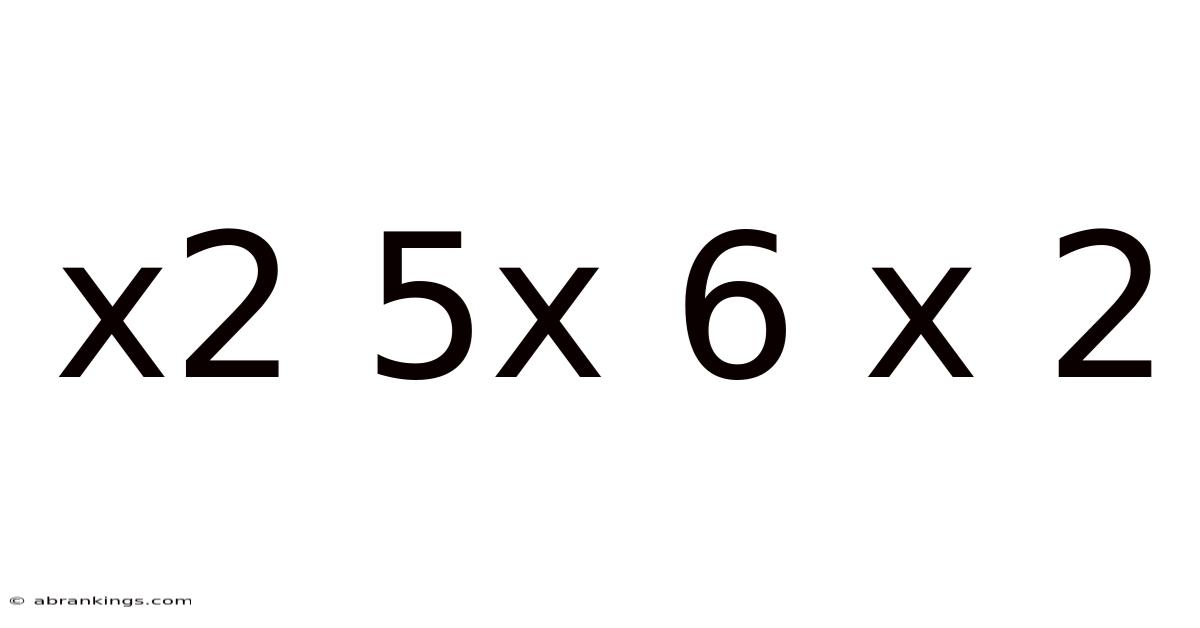
Table of Contents
Introduction
In the realm of mathematics, particularly in algebra, expressions involving variables and coefficients can often seem daunting. One such expression is x² + 5x + 6. This quadratic expression is fundamental in various mathematical applications, ranging from solving equations to graphing parabolas. Understanding how to manipulate and factor such expressions is crucial for students and anyone working with algebra. In this article, we will delve into the intricacies of the expression x² + 5x + 6, exploring its components, methods of factoring, and its significance in mathematics.
Detailed Explanation
The expression x² + 5x + 6 is a quadratic expression. A quadratic expression is any polynomial of degree two, which means the highest exponent of the variable (in this case, x) is 2. The general form of a quadratic expression is ax² + bx + c, where a, b, and c are constants. In our expression, a = 1, b = 5, and c = 6.
To understand this expression better, let’s break it down:
- x² is the quadratic term, indicating that the variable x is squared. This term determines the shape of the graph of the equation, which is a parabola.
- 5x is the linear term, which influences the slope of the parabola and how it intersects the y-axis.
- 6 is the constant term, which represents the y-intercept of the parabola when x equals zero.
The overall behavior of this quadratic expression can be analyzed through its graph, which is a parabola that opens upwards since the coefficient of x² (which is 1) is positive.
Step-by-Step or Concept Breakdown
To factor the expression x² + 5x + 6, we can follow these steps:
- Identify the coefficients: From the expression, we know that a = 1, b = 5, and c = 6.
- Find two numbers that multiply to c (6) and add up to b (5). In this case, the numbers are 2 and 3 because:
- 2 × 3 = 6
- 2 + 3 = 5
- Write the factored form: Using the numbers found, we can express the quadratic as: [ (x + 2)(x + 3) ]
Thus, the factored form of x² + 5x + 6 is (x + 2)(x + 3). This step-by-step approach is essential for simplifying quadratic expressions and solving equations.
Real Examples
Let's consider how x² + 5x + 6 can be applied in real-world situations or mathematical problems.
Example 1: Solving the Equation
If we set the expression equal to zero, we can solve for x: [ x² + 5x + 6 = 0 ] Factoring gives us: [ (x + 2)(x + 3) = 0 ] Setting each factor to zero yields:
- (x + 2 = 0) → (x = -2)
- (x + 3 = 0) → (x = -3)
Thus, the solutions to the equation are (x = -2) and (x = -3). These solutions represent the x-intercepts of the parabola, where the graph crosses the x-axis.
Example 2: Graphing the Expression
When graphing the expression y = x² + 5x + 6, we can use the factored form to determine key features of the parabola:
- The vertex can be found using the formula (x = -\frac{b}{2a}). For our expression, this gives: [ x = -\frac{5}{2 \times 1} = -\frac{5}{2} = -2.5 ]
- Substituting (x = -2.5) into the original equation gives the y-coordinate of the vertex.
Understanding these applications not only reinforces the mathematical principles behind the expression but also showcases its relevance in various contexts.
Scientific or Theoretical Perspective
The theory behind quadratic equations is grounded in algebraic principles. Quadratic equations can be solved using various methods, including factoring, completing the square, and the quadratic formula: [ x = \frac{-b \pm \sqrt{b² - 4ac}}{2a} ] This formula provides the solutions for any quadratic equation, allowing for quick determination of roots without needing to factor the expression manually. The discriminant (b² - 4ac) tells us about the nature of the roots:
- If positive, there are two distinct real roots.
- If zero, there is one real root (a repeated root).
- If negative, the roots are complex.
Understanding these theoretical aspects enhances our comprehension of quadratic functions and their behavior.
Common Mistakes or Misunderstandings
One common mistake when working with quadratic expressions is misidentifying the factors. For instance, a student might mistakenly think that the factors of x² + 5x + 6 are (x + 1)(x + 6) because they add up to 7 instead of 5.
Another misunderstanding is neglecting the importance of the leading coefficient (a). If the leading coefficient is not 1, the factoring process becomes more complex, requiring additional steps, such as using the method of grouping or applying the quadratic formula.
FAQs
1. What is the significance of the quadratic term in the expression?
The quadratic term (x²) determines the shape and direction of the parabola. It influences whether the graph opens upwards or downwards and is crucial in identifying the vertex and axis of symmetry.
2. How can I find the vertex of a quadratic function?
The vertex can be found using the formula (x = -\frac{b}{2a}). Once you have the x-coordinate, substitute it back into the original equation to find the y-coordinate.
3. What does the discriminant tell us about a quadratic equation?
The discriminant (b² - 4ac) indicates the nature of the roots. A positive discriminant means two distinct real roots, zero indicates one real root, and a negative discriminant indicates complex roots.
4. Can all quadratic expressions be factored?
Not all quadratic expressions can be factored neatly into integers. Some may require the quadratic formula or completing the square to find the roots.
Conclusion
Understanding the expression x² + 5x + 6 is essential for mastering quadratic equations and their applications in mathematics. Through factoring, we can find solutions to equations, graph parabolas, and explore various mathematical principles. By grasping the concepts discussed in this article, students and enthusiasts alike can enhance their algebraic skills and appreciate the beauty of quadratic functions in mathematics.
Latest Posts
Related Post
Thank you for visiting our website which covers about X2 5x 6 X 2 . We hope the information provided has been useful to you. Feel free to contact us if you have any questions or need further assistance. See you next time and don't miss to bookmark.
